Friday, August 17, 2012

déjà vu


We’re hearing sounds coming from Israel that echo those heard here during the run up to our Iraq fiasco.  That is deeply disturbing and frightening.  As reported in the New York Times, “[Defense Minister Ehud Barak] acknowledged in Parliament that there were differences over how to deal with Iran, but insisted that the issue was being debated here more thoroughly than any other he could remember.”  Could Donald Rumsfeld and Condi Rice have said it any better?

from Daily Beast
Israeli leadership sees Iran as an existential threat. That may be the case, and I’ll get back to it.  What I fear at this moment is that the Netanyahu-Barack government may be misreading the American Jewish community and its unquestioned support for current policy, or very sadly for that matter, for Israel itself.  Just as Republican candidates speak mostly to Fox News, it seems Israeli leaders  interact largely with the AIPAC types wishfully thinking they represent American Jews at large. 

In fact the now infamous casino billionaire and his fellow right wing conservatives are the exception not the rule.  Relying on them will lead to disappointment, and worse, a gross miscalculation.  Like so many Americans across the spectrum, Jews in this country (who mostly skew liberal and Democratic) have little taste for wars these days and most especially preemptive attacks.  If added to his miscalculation of assumed support, Americans sense that Bibi is trying to manipulate the results or our presidential election, or is blackmailing Barack Obama into some action, the backlash is likely to be even worse. 

There would be nothing good about Iran going nuclear.  By the same token there was nothing good about India, Pakistan, Korea and, yes, Israel going nuclear.  In each of these cases, you could say that the countries involved pose an existential threat to their adversaries, but let’s not forget the rhetoric of the Cold War.  Remember those backyard bomb shelters and kids hiding under desks preparing for the worst?  The Soviets also said they would wipe us off the map. They had both an arsenal and capability that dwarfs anything that will be found in the newer members of the nuclear “club”.

Wikipedia
Clearly Israel could use its current nuclear arsenal to wipe out Iran and some other adversaries as well.  Obviously it hasn’t done so and with very good reason.  Only the United States has ever used nuclear weapons.  That was in the closing days of WWII when it dropped two bombs on Japan, nukes that were primitive relative to later technology.  They were, however, enough to make the point.  Nuclear weapons, from a practical standpoint, are so destructive as to be totally useless.

The real problem with Iran is not so much that it might nuke Israel which would in the end be suicidal, the problem is proliferation and the risk that some rogue group might get it’s hands on a nuke and in some nihilistic rage deploy it.  That is precisely what we worry so much about with Pakistan and probably why, despite all the bluster, we worry less about with North Korea.

Does Israel feel threatened?  Of course it does.  Do its current leaders also use this threat, calling it existential, for their own political purposes?  Yes they do just as George W. Bush played 9/11 for all it was worth, leaving other people’s sons and daughters to die on the battle field or be scarred for life.  Supposed existential threats kept warmongers in power here in the early Cold War. The so-called Communist menace didn’t destroy America, but those who used it for their own purposes did do a job on many of its best and brightest citizens including actors and intellectuals.

I do fear that Israel faces an existential threat, but it is one closer to home.  The clock is ticking and the only leaping demographic growth in this very advanced society is to be found among ultra-orthodox Jews who don’t want to give up an inch of land and also among poor Palestinians who might well outnumber Jews in a single state.  Arab and Iranian leaders use the Palestine/Israel limbo to distract their people from their own, often dire, internal problems.  But so too has the Iran “threat” become a smokescreen to distract Israelis and the world community from addressing Israel’s real existential threat.  That’s what makes this so sad and so destructive.

Stay tuned an expanded exploration of people living beyond religion in book form coming soon.


Thursday, August 16, 2012

Another Spring


If there is any characteristic that seems to join otherwise disparate Arab leaders facing their spring, it is desperation.  No one exhibits that more than Bashar al-Assad.  The West trained ophthalmologist was reluctant to take on leadership of the family business.  At the start he came off as a reasonable reformist.  In almost Jekyll-Hyde fashion the Assad we see today has morphed from mild mannered doctor into ruthless monster.  When your world is threatened you do desperate things.

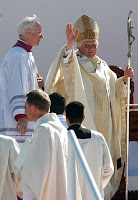
Albeit in a profoundly different way, the same desperate reaction seems to be taking hold in Rome these days as the pope and his princes take on what they undoubtedly see as revolutionary threats to their own realm.  Benedict began as his predecessor’s enforcer and perhaps only during his own reign have we been given a more accurate window into how truly conservative the charismatic John Paul II really was.  Remember that Benedict was elevated just one day after the start of April 2005 conclave.  It would seem that succession had been set before John Paul’s death.  Benedict is likely to follow suit.  He has now appointed more voting and like-minded cardinals than his successor, and his reign has not ended.

The Roman church has never claimed to be a democracy.  From the early days it has had top down leadership from an infallible and authoritarian pope.  So its tolerance for dissent or any deviation from established doctrine has been very limited, often non-existent.  That has especially been the case when the Church sees itself under threat, something that has happened at times throughout its history. 

That is likely why Rome, in an assertion of absolute power, has come down so hard on the American Leadership Conference of Women Religious, placing its member nuns under the control of three male bishops.  It seems clear that it is willing to jettison a critical component of Church personnel — 80% of American nuns — to make the point.  In their just completed national assembly held in St. Louis, the LCWR agreed to seek open dialogue with Rome.  But there was no sign that the nuns were willing to back down.  So where these talks will go remains an open question, an ongoing problem for the Church.

Now, adding to that comes the report of Rome’s apparent intention to strip the Pontifical Catholic University of Peru of its name, and more importantly its right to call itself Catholic.  Beyond the question of Papal authority, the conflict in Lima reflects the same kind of right/left struggle that has taken over our politics here and around the world.  It is a battle for supremacy between conservatives who are increasingly ultra-conservative and progressives: moderate or liberal.

The Peruvian struggle is of particular interest since it involves two twentieth century created movements within the church, both of Hispanic origin.  On the conservative side is Opus Dei founded by the Spanish cleric Josemaría Escrivá de Balaguer in 1928.  This once fringe right movement has found a receptive audience in the current Vatican.  Among those Americans who attend mass at Opus Dei oriented churches are Justice Antonin Scalia and former Senator Rick Santorum.  On the other side is Liberation Theology a populist approach with 1950s-60s roots in Latin America.  One of its leading exponents is Gustavo Gutiérrez, the Peruvian priest who coined the word, and a leading faculty member of the university.

Are these alone — a group of independent thinking nuns and a similarly inclined university — enough to make Rome desperate?  Probably not, and the pope would surly challenge any such notion of desperation on his part, and vehemently so.  But add to these two the just released poll by the research consortium WIN-Gallup International about the dramatic decline of religiosity in the world.  It focuses on changes that has taken place in just the last seven years, most notably in Catholic Ireland.  Today, only 47% of the Irish consider themselves religious, that’s a drop of 22 points from the 60% reported in 2005.  If some nuns and academics don’t drive Rome to distraction, then these numbers certainly must.  Perhaps the Church isn’t entirely losing its grip on the faithful, but it is clearly losing ground at what should be seen as an alarming rate.

The WIN-Gallup poll should be a wake-up-call for all religious groups.  Religiosity worldwide has fallen 9 points in the last seven years.  People who call themselves religious today represent 59% of the population, down from 68%.  An even larger drop has been experienced in the United States (13 points) from 73% in ’05 to 60% today.  We may still call ourselves the most religious country, but it’s fast becoming a hollow claim. 

Stay tuned for some news on an expanded exploration of people living beyond religion in book form coming in the near future.

Image from Wikipedia

Sunday, August 12, 2012

Excellent Choice


With our mania for beauty contests and preference for catchy bumper stickers, American elections are all too often scrubbed of substantive content.   That may well explain in part why we live in a country with such a poorly informed electorate.   Judging by the weeks since Mitt Romney secured the GOP nomination, 2012 seemed to be following the same tired script.  That was particularly troublesome because down on the ground the country has been caught in a sometimes-vicious tug of war between opposing philosophical views that speak to the very nature of our democracy.  So while the campaign talk ranges from glib to vague, we stand at a very real crossroad.  The turn we take now may actually determine our road to the future.

I have long felt that, despite some surface similarities, the differences between our two major parties are significant.  It did matter that Jack Kennedy became president in 1960 and that George W. Bush prevailed in 2000.  Yes it’s often hard to differentiate been Democratic and Republican administrations in foreign policy.  Regardless who sits in the White House, we’re still the same superpower that must react somewhat consistently to events and situations largely out of our control.  On the domestic side however, the place where we actually live, the divide has been getting larger the differences more transparent.   Here we are in control.  Different policy can and does make a difference.

It is in that context that I think Mitt Romney has made an excellent running mate choice.  In a sense the chameleon of American politics has decided to run on a clearly articulated and documented philosophy.  Perhaps it’s emblematic of his candidacy that from here on in he will be running on someone else’s (yet another) record.  Think of that what you may, but Paul Ryan’s record puts the right-left divide into sharp campaign relief, much sharper than was the case just two days ago.  And that’s a really good thing.

It has long been said that budgets are where the philosophical rubber hits the road.  It’s not what we say, but how we gather and then allocate our resources.  Budgets ultimately boil down to what we’re spending and what we’re cutting.  As such they remain the best reflection of our national and local priorities.  Ryan’s budget (and everyone calls it that because he is its principal author) isn’t some vague pronouncement but is concrete  — hard fast numbers embedded in a bill passed by the Republican dominated House.  Romney now has a record driven by a clear ideology behind which he must stand and which he must defend.  He has made a choice and that’s exactly what we will have to do.

Some partisans will rush to say that Romney committed political suicide on Friday.  Not so fast.  Vice Presidential choices have rarely decided elections one way or another.  Whatever strengths are bringing Romney the nomination might get him to the presidency.  Ryan may have views with which you or I might disagree, but he is a fresh and youthful face who will now be paired against a much older and established counterpart.  If Vice Presidents stand as symbols for the future that could be meaningful, though perhaps not with a 51-year-old President in good health leading the ticket.  We don’t know how Ryan will perform on this much larger national stage or how the Romney-Ryan combo will stand up against Obama-Biden.  Elections aren’t over until they’re over, and one should be wary about suicide predictions.  The last time was when G.H.W. Bush named his Veep choice.  Remember President Bush and Vice President Quayle?

Ryan is an excellent choice because it might force both campaigns to engage seriously on their philosophical differences and where the country should be headed.  How, who and at what level should citizens be taxed?  What kind of safety net should a great democracy provide for its citizens?  What are our priorities say for example between education and armaments?  What is the government’s responsibility, and through it the citizen’s responsibility, for things we all use like our infrastructure?  How should the government intersect with our private lives and how separated should church and state be?

Even with a more ideologically defined race, don’t expect all of these issues to be addressed, certainly not with total clarity.  After all this is America where those who speak seriously about issues are branded wonks and nerds.  But perhaps we can look forward to something more this time around.

Regardless as to how the next months will play out, we Americans are faced with a clear choice this election cycle.  We deserve to understand not only the issues facing us but that we are in fact making a defining choice when casting our ballots.  Mitt Romney may not have given us much until this point, but hopefully his excellent choice will make us all stand up and take notice  — give us greater reason to vote for or against him in November.  For me, if anything, voting against him and for Barack Obama is even more of a no-brainer.

Wednesday, August 1, 2012

What a trip!


Even before it began, a distracting etiquette gaff marred Mitt Romney’s trip to London.  Were that not enough, he added a controversial pre-departure interview with The Daily Telegraph.  In it he spoke of his special connection with the Brits because of our shared Anglo-Saxon heritage.   To make certain that was clearly understood, an advisor added that The White House didn’t fully appreciate the shared history we have.  Of course, its current occupant isn’t an Anglo-Saxon, which I would guess would explain the claimed disconnect.  Here we go again, a not so thinly veiled code for what has become a recurring theme if not in, then certainly around, the Romney campaign.  Of course, perhaps these statements aren’t meant as code but that, as suggested in an earlier post, Mitt is just out of touch — so clueless that he knows not of what he speaks.  I don’t know what’s worse.  You be the judge.

That brings me to the curious but also transparent Israel trip.  Both presidential candidates have been raising money abroad, largely from ex-Pats and Mitt pulled in a pile of dough from a $2,500 a head gathering in London.  But the trip to Israel was something else entirely.  In what looked to me more like a United Jewish Appeal (UJA) mission for the well healed than a maiden trip abroad as the presumptive nominee, Romney actually brought the donors with him.   The UJA mission type entourage was led by gaming king Sheldon Adelson, the GOP’s new super star sugar daddy (Frank Rich’s designation).  25% of the Jerusalem speech audience, one of the few he delivered, was made up of those American donors who had come to the Holy Land specifically to give Romney money.

If you don’t quite see this as a faux religious fundraiser, consider Romney’s remarks to the assembled.  I am overwhelmingly impressed with the hand of providence, whenever it chooses to apply itself, and also the greatness of the human spirit, and how individuals [donors] who reach for greatness and have purpose above themselves are able to build and accomplish things that could only be done by a species created in the image of God.  Wow, divine instructions to fill the candidates coffers and almost in sight of the Western Wall, newly stuffed with a Mitt prayer.  This will certainly go down as one of the greatest fund raising props ever used by a candidate for the American presidency.

There was an unmistakable smell of pandering in the Romney visit — pandering combined with etch-a-sketch.  The first came with Romney’s proclaiming his support for the military action rightist Israeli leaders talk so loosely and regularly about but which flies in the face of American policy.  While leaving no option off the table, our current focus is on diplomacy and sanctions.   It should be said that, red meat Republican rhetoric aside, most American voters are tired of wars and, based on recent experience, have good reason to wonder if they work. 

Then came the comments true to what has become Romney’s etch-a-sketch MO  It can be simplistically described as flip-flopping but more accurately is reflective of a man who seems totally lacking of conviction. Romney, as Massachusetts governor, signed what would become the model of the national Affordable Care Act.  Then presidential candidate Romney disavows and vigorously denounces exactly what he signed into law.  Finally, in full pandering mode, he tells an Israeli audience that they have healthcare that is superior to ours.  Come again, Israel has universal health care with a mandate to boot.  I can only paraphrase the question Joseph Welch asked Senator McCarthy nearly fifty years ago: have you no shame, sir?  

The White House shouldn't feel singled out by that pre-London Anglo-Saxon remark.  Romney it seems can’t help himself.  At one point during his Israel visit, he drew a  cultural differences distinction between Israelis and Palestinians suggesting that they accounted for the success of first and the lack thereof of the second.  Forget that he then offered statistics that were inaccurate or that he ignored that one group ruled its own country while the other lived under military occupation.  For the Palestinians there was no code involved, just a clear message which Saeb Erekat, a senior aide to President Mahmoud Abbas simply called racist.  A really good start in foreign relations, Mr. Romney — a really good start.

Finally, again out of sync with US policy, Romney referred to Jerusalem as Israel’s capital and promised to move our embassy there when he was president.  Our bi-partisan policy is that the designation of a capital would have to await negotiations since both parties now claim it.  But what struck me was that just days before Mitt set off for the Holy Land the New York Times carried an op-ed penned by Dani Dayan, Chairman of the Yesha Council of Jewish Communities in Judea and Samaria, the place most of us know as the West Bank.  I don’t think it’s a coincidence.  Dayan, no relation to the fabled Israeli General, is a high tech entrepreneur who opposes a two state solution and, while secular, is a leader in the largely ultra-orthodox settler movement.  As Tom Friedman points out in his column, Dani Dayan reads the Romney trip, and most especially the rise of influentials on the right like Adelson and Aipac, as a victory for the settlers.  Indeed a Romney presidency would rekindle the rightist axis that existed between his host and former Boston Consulting colleague Bibi and the Bush-Cheney administration.  Yes, Obama and Netanyahu aren’t warm pals, but under his presidency Israel has actually received more military aid than from any other.  As I have written before, the single state solution far from strengthening the Jewish state is likely, in the long run, to destroy it.

Sunday, July 29, 2012

Restoration


As unbelievable as that may be (especially to me), I spent close to a decade on Wall Street.  No one was more ill suited, but much of my years there were spent working for Sanford I. Weill.  That made for an interesting time.  When I arrived, Sandy and three equal partners ran what was still a relatively small boutique brokerage.  They sat together in one large room, identical chairs and desks.  The message: no single top dog at Cogan, Berlin, Weill and Levitt.  The market dropped significantly on the day I arrived and never totally recovered during my tenure.  Took me a long time to take the hint.  It was a bear market but not for CBWL.  Beginning with its acquisition of the old line but tottering Hayden Stone, Sandy’s firm started on what would be a path toward phenomenal growth.  Within a relatively short time, Shearson Hayden Stone, as it became known, was an industry powerhouse and Sandy was its undisputed chief executive — What W would call, the decider.

I had left by the time Shearson was sold to American Express ultimately leading Sandy down a different and somewhat circuitous road.  It would ultimately put him at the top of the world’s largest financial supermarket, Citigroup.  In the final stretch of that journey, Sandy played an outsized role in convincing Bill Clinton and the Congress to overturn Glass-Steagall, the post Depression legislation separating commercial and investment banks.  The Gramm Leach Bliley Act enabled his Travelers Group to merge with Citi giving birth to the behemoth bank that we all now know would be too big to fail.

Fast forward to last week when the same Sandy Weill, who had retired from Citi shortly before Wall Street’s house of cards began to crumble, used an appearance on CNBC to advocate for what amounts to a reinstatement of Glass-Steagall.  While underreported, he had dropped a bombshell.  It would probably be too much to ask that Sandy fess up to being wrong in the 1990s — he simply says times have changed and what was right then is no longer.  One could judge him harshly for that, and rightly so, but he is just following the norm, a long line of business and political leaders who find themselves incapable of ever saying, I was wrong.  Indeed, Sandy has gotten a lot of flack about his change of heart including from Jon Stewart (called to my attention by Phyllis Prinz).

And hardly surprising, his biggest critics come from the community of which he has been a lead player.  These are the people who sit atop or benefit from today’s too big to fail banks.  Among them are those who have been raking in billions, some making their own trades with what may be customer money.  As far as I can tell, neither Bill Clinton nor his former Treasury Secretary Bob Rubin (who ended up in Citi’s executive suite), prime supporters of Gramm Leach Bliley, have reacted, certainly not publically.  Sad to say, what we can expect is that any real discussion about reinstating Glass-Steagall type controls might be conveniently deflected by a critique of Sandy Weill.  He is the perfect target.  Focusing on the messenger here, no matter what he did in the past, is to miss the point and more importantly, to miss an opportunity to do something.

You might say that Sandy Weill is being hypocritical.  That what we saw on CNBC was a self-serving rich guy trying to burnish his tarnished image.  You may be right, no let’s say you are right.  Feel better now?  Pointing that finger may give us some satisfaction, but we may find ourselves with nothing more than a hollow self-indulgent moral victory.  Not having talked to, much less seen, him in years, I have no way of knowing or being able to judge his motivations.  What can be said is that, considering what’s at stake, and the potential of being side tracked from the very real issue at hand, perhaps we should give him a pass, even if a conditional one. 

Aside from a chance and brief encounter in Zabars a few years ago, I haven’t talked to Sandy in years, but I knew him very well.  He was a man of considerable integrity.  He and his wife Joan have contributed millions to good causes from supporting hospitals to Carnegie Hall.  But what you should know is that he is one of the smartest and most thoughtful executives I have ever encountered, and there have been many.  As Hercule Poirot would say, Weill's grey cells were always working, usually at double speed and over time. 

Perhaps the terrible things that have happened in the aftermath of overturning Glass-Steagall were predictable.  A good number of Senators including Bryan Dorgan, Barbara Boxer, Barbara Mikulski, Richard Shelby, Tom Harkin, Russ Feingold and Paul Wellstone opposed it.  But for a while the economy and business appeared (and I used that word intentionally) to be thriving.  Money was being made on both Wall Street and Main Street and no one, including John Q. Public, was asking questions.  Hear no problem, see no problem and for heaven’s sake, speak no problem.

Sandy is right; times have changed.  Oh, have they changed.  It isn’t only that the banks are too big to fail, but that they are too big to be either managed or supervised.  If Sandy’s protégée Jamie Dimon couldn’t spot a multi-billion dollar loss before it was too late, we know that to be the case.  Sandy was one to keep tabs on every dollar even as the dollars multiplied and one has to assume that Dimon was trained to do the same.  The problem is that, while companies may scale up, an individual human’s capacity has its limits — at some point it can’t keep up.  Of necessity, deciders these days rely on subordinates and are even unable to know what they are doing on a daily basis.

Breaking up the banks would likely be good for our financial system, but my guess is that it would also produce a lot of new jobs.  Economies of scale, the kind of thing that equity people like Mitt Romney tout, always involve consolidation of services and thus a loss of jobs.  The newly separated institutions would require their own infrastructures — specifically mandated to be separate. 

So, yes Sandy you didn’t apologize, and maybe you are trying to burnish your own tarnished reputation, but let’s give you the benefit of the doubt.  Of course making one comment in one TV appearance won’t be enough to say you are serious.   Taking a further risk to alienate your old pals and expose yourself to criticism will be required.  I hope your words won’t be ignored because further disasters lurk and too many people in your old business are acting as if nothing bad has already happened.  Business as usual doesn’t cut it.  No, business as usual is just plain frightening!

Monday, July 23, 2012

Un-American.


I wish this president would learn how to be an American.  These were the now much quoted words of Mitt Romney’s Cuban born attack dog John Sununu.  He, the former governor went on, has no idea how the American system functions, and we shouldn't be surprised… he spent his early years in Hawaii smoking something, spent the next…in Indonesia,…and…as a community organizer, which is a socialized structure. The president, who doesn’t understand how America works, flew out to Colorado on Sunday to participate in an especially American ritual: comforting families of civilian gun violence victims.  What appears to be truly American is that there are more weapons — hand guns and assault rifles — in the possession of individuals here than in any developed democracy.  And also very American it would seem is that we have the highest incarceration rate in the world, a disproportionate number of prisoners being African Americans.  If that’s how America works, I frankly don’t understand it either.

But John Sununu’s verbal attack bespeaks something far more disturbing.  While opponents have vilified virtually all of our presidents, no other chief executive has been called un-American.  So it’s hard not to conclude that what we’re hearing from Mr. Sununu and his ilk is good old-fashioned code.  And it’s a code familiar to any person of color or with a foreign sounding accent.  I had hoped that we were through with that stuff once President Obama won his majority victory in 2008, but I was wrong.   Sununu has apologized of course, but his words hang our there never to disappear from the eyes and ears of the receptive in cyberspace.

John Sununu, who you will remember was known for his sharp tongue while serving as Papa Bush’s chief of staff, is simply continuing a tradition of disrespect that started early into the Obama presidency.   It was then that, in a virtually unprecedented breach of public etiquette, the  words you lie (referenced in previous posts) were shouted out by South Carolina’s Joe Wilson during a presidential joint session address.  After all, for people like Wilson (and assumably Sununu) that outsider didn’t belong there in the first place.  In the same meanspirted way, Racist Arizona Sheriff Joe Arpaio recently boasted that he has launched yet another spurious Birther investigation into the president’s definitely fraudulent birth certificate.  And this guy may well win reelection.

Meanwhile Mr. Romney remains above the fray.  He has kept his friend John Sununu on the job as a primary surrogate; being satisfied that the former governor admitted to unfortunate language.  He can afford to do so because nobody doubts that he, unlike the president, is a real American.  How do I know that?  Because, as is the way with other super rich real Americans, he successfully avoids taxes with offshore accounts and the like.  As the presumptive nominee declared in January, I pay all the taxes that are legally required and not a dollar more.  I don’t think you want someone as the candidate for president who pays more taxes than he owes.   Oh, that’s precisely what I was thinking.  This man really understands how America works, at least how it works for the 1% of which he is a proud part.  Isn’t he the kind of president your want?

Let’s have a cheer for such real Americans, the kind that contemporary Republicans and their Tea Party constituents so admire.  If that were possible Abe Lincoln would be turning in his grave.  Even George W. Bush wants no part in the convention that will nominate this real American.  Thought, I’d never say it, but Amen W.

Wednesday, July 18, 2012

Reverse.


Can Liberal Christianity Be Saved?  That’s the question posed by Ross Douthat, the always interesting conservative NY Times columnist and a committed Roman Catholic.  Of course, the same can be asked about Liberal Judaism or Islam. Better yet, would be to question if liberal religion is viable in the first place.  Taking the long view, a strong argument can be made that it is not.  The orthodox across all religions share one thing in common.  For them religion is essential to their being, as natural and necessary as breathing air.  They make no real distinction between the holy and the profane.  Consequently, life is a cohesive and integrated whole where religious practice is not an option but a necessity.  In contrast, the non-orthodox (while certainly not monolithic) generally approach religion as something to be done, often at a specific time and place.  I like to describe it as by appointment.  Appointments are meant to be kept but, the best intentions notwithstanding, they are often to be missed, something that can become a habit, feeding on itself.

With that in mind, it’s not surprising that orthodox leaders like the Pope whom Douthat references, stand fast against any liberalization.  They pushback against Vatican II-like reforms, seeing them as dilutive and ultimately destructive.  It’s hard to argue with that conclusion.  And that’s precisely what concerns Douthat even though he recognizes that progressive religion has played a key role in civil rights and other efforts aimed at bettering our society, what Jews call tikun olam.

At the same time, just as taken to its logical conclusion, liberalization may lead to destruction, we should not overlook the chicken and egg question.  Liberal religion may be positioned as modernizing belief and practice, but is it rather reactive — aimed at saving something that would otherwise be lost?  There is considerable data suggesting that people in the West (including the United States) are moving from religion at an accelerating pace.  They may be exiting from liberal churches and synagogues but also from the orthodox.  Only the influx of Hispanics can mask the full dimension of Catholic Church losses better seen in the forced closing of many parishes and schools.  Only 40% of those brought up as Orthodox Jews remain so as adults.

So the question posed by Ross Douthat may be interesting but it is ultimately the wrong one.  Considering current trends — the doubling of the no-religion-at-all group in the last decade — shouldn’t we be asking if religion can be saved?  I’d suggest both orthodox and liberal religious leaders, admit it or not, have that question top of mind and have developed different strategies in response to the perceived danger.

The orthodox are turning inward, hitting the reverse button if you will.  Their religion is becoming narrower, more doctrinaire and often more militant (in some cases violent).  They are closing all windows and drawing all shades to avoid even a trickle of air or light that might disrupt their way.  It is why Rome is reining in their nuns, which Douthat sees as something being done for their own protection.  I don’t buy it.  By the same token, liberals are desperately trying to find innovative ways that will engage their constituents while simultaneously hitting their own reverse button.  For them this means dipping into the tradition and in some instances reinstating customs if not ideas that had been previously abandoned.  All the while, they know that without embracing modernity they can’t sustain the flock or themselves.  A conundrum to which there is no easy response.

These are very different strategies and both may ultimately constitute short-term fixes.  The Higgs bosom is not the God particle, but a bit of matter that will give scientists greater insight into our origins; insights that obviate any Let there be.  Religion has been around a long time and it is sure survive far into the future.  It remains more resilient in some places than others, in some pockets even in places hostile to its teaching.  It survived Stalin.  But, as life itself, religion — the adherence to what some of us believe — is likely to be finite not eternal.  Measured against the rigors of scientific testing, it falls short.  The radical idea of religion as finite, is something its followers don’t dare consider because that, not liberalism or orthodoxy, is a real game changer.