-->

Monday, March 18, 2013

Lean In

 
In September 2011, badly needing redirection, the iconic Hewlett-Packard — famously founded in a Palo Alto garage — reached out to Meg Whitman.  The new CEO had recently lost a bid to become California's governor, but had a strong track record.  In over ten years at its helm, she had helped transform EBay from fledgling enterprise into an Internet powerhouse.  Meg Whitman belongs to a still very small and select class: the woman chief executive.

Last summer Yahoo, yet another Silicon Valley trailblazer founded by Stanford trained engineers, was seeking a way to get back on track after years of setbacks and management turmoil.  It turned to Melissa Mayer who rose from employee number 20 to senior executive at Google.  Meyer arrived in Sunnyvale in her final weeks of pregnancy, something that probably made as much news as her becoming the youngest CEO of a Fortune 500 Company.  After a little more than six months on the job, Mayer took a drastic step for a free wheeling company many of whose employees worked from at home, in some cases all of the time.  She essentially called everyone back to the office, a move aimed at reconnecting and thus energizing the work force to be more mutually creative.  It caused a firestorm both within the company and perhaps more so in the media.  How could SHE?  Among the many criticisms aimed at Ms. Mayer were ones that related as much to who she was as what and why she was doing.  How could a woman, of all people, essentially end flextime?

The special treatment given to Mellissa Mayer is not new to the select number of women who have reached the higher echelons of their chosen profession or workplace.  No doubt Meg Whitman experienced much the same over the years.  Women, for example, are routinely described as "bossy" when doing the same leadership thing that would be, and is, admired in a male counterpart.  Sadly, few women climbing the career ladder are willing to publically or even privately confront this or other forms of ongoing gender discrimination.  Instead they play along in the hope of continuing their advancement and in constant fear of hitting the proverbial glass ceiling, or worse losing their jobs.  Rather than challenge, many speak only about how much progress has been made since the advent of the Women's Movement, a subject or rather a myth that I have discussed in previous posts and in my book.  Now Mayer’s former Google colleague, and presently Facebook COO, Sheryl Sandberg has broken that acquiescence, that silence.
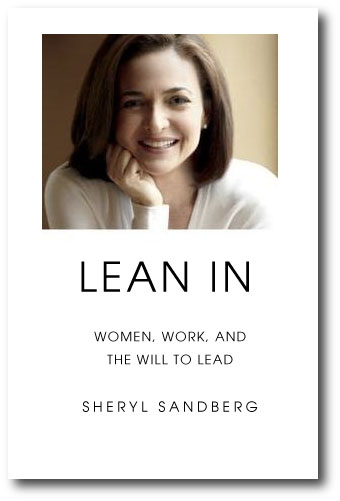
In some ways Lean In is a highly personal book, one that reflects Sandberg's own journey from a happy Miami childhood through entry level and then senior positions in the public sector and ultimately in business.  Unlike Melissa Mayer who, as a Stanford trained engineer, took the expected Silicon Valley path, Harvard economics major and then MBA Sandberg came to the tech world from the Treasury Department.  Despite reaching her goal through smarts (top honors in school), hard work and merit, hers is hardly a Horatio Alger story.  She came from a nurturing affluent home with a well-educated mother and ophthalmologist father and with siblings, one a surgeon and the other a pediatrician, who also went on the bright careers.  Along the way, she had great mentors, not the least her thesis adviser at Harvard, Larry Summers, for whom she later worked both at the World Bank and at Treasury.  It's not a starting from scratch story.  Rather, and more importantly, it's the kind of career that mirrors the one of many in senior positions, public and private.  So you might say, Sheryl Sandberg came up in the usual American way.

Usual that is for a man.  Her life and the challenges presented at every stage didn't so much mirror that of male colleagues but of women in this country.  And that isn't only women in the workforce, but all women: how they are judged, what opportunities they encounter and what outcomes they have in life.  As Sandberg points out time and again, women are seen differently, paid less (than men doing the same job and underpaid in the absolute), passed over more, and must function with an often unspoken but always present handicap.  Even fifty years after the modern Women's Movement made such a splash, women hold few top jobs (or even an equal number of jobs) in business, government or institutions.  That means fewer CEOs, Senators and Members of Congress, college presidents, clergy etc. than their male counterparts.  Fifty percent of the population doesn't translate into 50/50 in the workforce.  And that workforce includes at home where few women enjoy truly 50/50 partnership with their spouses, something Sandberg considers an unmet essential.  In a revealing anecdote, she reports of a man telling a colleague that he has to go home to "babysit".  Imagine a woman characterizing being with her children as "baby sitting".  In both cases, is that something called parenting?

Sandberg's book is receiving a lot of attention and a substantial amount of flack, some of it from women reviewers.  She has been accused of speaking from a privileged place — extreme wealth and power, hardly the average woman — and for name-dropping — admittedly her acknowledgment pages especially are a little over the top.  But from beginning to end, I found an author well aware of who and what she is and certainly of her unique position.  In fact, it is because she has done so well (and clearly because she didn't have to) that she felt compelled to address gender issues head on.  Perhaps this book was written to inspire other women, but also to express honestly what they face and what they likely think but fear to communicate.  It is a compelling fact filled book that, while certainly not faultless, should be read by both women and men.  It's pages turn quickly but its message can't be taken in, hit and run.  It requires deliberate and lengthy consideration.

We most certainly can thank men for the still held back role of women in our society.  Our prejudices (or more accurately pre-conceived notions) and in recent times our fear of competition have been, and continue to be, at play.  The fabled Horatio Alger's in the American story may have come from humble beginnings, but they shared the distinct and common advantage of maleness.  They started with a leg up.  No one suggested that they didn't have the physical strength or temperament to do their job; no one assumed in advance that they would be moody or considered them bossy when they led.  Sandberg cites research showing that male leaders are both respected and liked while women doing exactly the same job, performing in the same way, may be also respected but are most often are considered "unlikable".  Some people think it a complement to say how well a woman is doing in a "man's job".  Yes, a man's job, not simply a job to be done.

But Sandberg doesn't place the entire burden and blame on men.  She knows that women can be their own worst enemies, both in not reaching as high as they should — limiting (sometimes purposefully) what opportunities they seek — and in often not standing up sufficiently for their female peers.  Lean In has been criticized for urging women to reach high, for perhaps putting too great a premium on both work away from home and on success.  It's a bad wrap, because Sandberg continually emphasises that we all face a range of choices and that no one should put a valued judgment on the path we chose to follow.  That said, this book's ultimate message to women is certainly that they should cast aside the mental and other barriers that might be in their way.  Women should lean in — be all in — to what they're dong, something that men have done, as if by second nature.

It isn't all men's fault and it isn't all women's fault.  I can't speak for women, but can for men who Sandberg urges to be, to become, true 50/50 partners including (and most especially) at home.  It isn't enough for women to be committed feminists.  Men must join them in what remains an uphill fight and unfinished business.  I'm so glad Sandberg points out that, despite her own success and the road already traveled thanks to Gloria Steinem and others like her, progress has remains quite limited.  I could not agree more.  I've always considered myself a feminist, still do.  So I invite you — especially men — to either join me in that for the first time or to reenlist. 

Say what you will about Sandberg's book, about her rarified perch, her dropping names, her first person account or any other criticism.  But this is ultimately a provocative work, a conversation starter.  And it is a conversation, an honest conversation about gender, in which we need urgently to engage.  Our future depends on all of us — men and women — leaning in.  If we are lagging behind these days, count our keeping women in their "place" as one of the reasons.  Blame it also in us men not being in there 50/50.  We may not have the power to do everything, but we do have the power to change that.

Note: Not surprisingly for a FaceBook executive, Cheryl Sandberg has started a community Lean In dedicated to this subject, a way to learn or get involved.  Check it out.

Friday, March 15, 2013

Francis I


Benedict is gone...they have a new pope.

Catholics and non-Catholics alike seem fascinated by the Vatican in papal transition.  With extended papacies like that of John Paul II there is a long lag between the conclaves.  Not this time.  So once again we all watch from afar as a group of red clad aging men, none elected to their positions of immense power, anoint one of their own to rule the Church.  The process is totally opaque with each voting member sworn to silence and secrecy.  Once white smoke appears atop St. Peters, a single now white hat emerges, no longer an equal among equals but the absolute and infallible Holy Father.

Considering that neither the Church nor the man will have even the slightest impact on most of our lives, what interests us so?  For one thing, passing the Catholic torch with all of its colorful costumes, ritual and pomp — yes theatrics  — makes for great television.  Then, too, there is the mystery of it all, complete with the aura of assumed and unseen intrigue.  Real life imitating fiction, or is it the other way around?  While we may rail against the lack of transparency in most of our institutions, here the lack of transparency only adds to the drama.  It provides a perfect and riskless setting for prognosticators.  Unlike political pundits and pollsters, they will never be scored on predictive accuracy.  After all, who knew?

If you're a Catholic woman seeking control over your reproductive rights, a gay man looking for full acceptance and marriage equality or someone in the pew hoping for an end of celibacy and the ordination, finally, of women don't expect the newly enthroned Pope Francis to be on your side.  Perhaps the choice of this particular Cardinal, Jorge Mario Bergoglio, came as a surprise.  That he would be in the doctrinal conservative mode of his two predecessors — the men who qualified him and his electors — was and is expected.  There were no reformers, as many of us would understand and define that word, in the voter/candidate pool assembled in the Sistine.

In the first hours and days after a pontifical elevation, one tends to focus on what this or that gesture might tell us about new pope's persona or foretell his rule.  We look for similar signs from anyone who ascends to power including our newly elected presidents.  Of course, with a long and largely transparent campaign, we know so much more about them.  The election of a pope is the polar opposite of transparent.  Its opacity is underscored when the winner has not been seen as a pre-conclave front-runner.  Despite his reputed strong showing in 2005 and being well known at home, Francis has arisen out of effectual obscurity.  Cardinal "who?" we say upon hearing of the Argentinian will lead more than a billion people around the globe.

So, having little else, atmospherics are likely to all we have to go on in near future — style more than substance.   That said, with no radical departure from doctrine expected to be in play, style might actually have more substance than is often the case.  By now anyone who reads or watches the news knows that Francis eschewed palace life in Argentina, opting instead for a modest apartment and self-cooked meals.  He passed up a limo in favor of a public transportation and indeed got on the Vatican bus with his Cardinal colleagues right after the election.  He picked up his bags the next day and paid his own hotel bill.  We also have been told of his interest in and devotion to the poor, of washing AIDS patients' feet.  He moved many by humbly asking the assembled crowd's blessing before bestowing any of his own on them.  These early acts and personal history suggest to some that he may well be more in the John XXIII mold than in that of either Benedict or John Paul.  Perhaps.

Francis assumes leadership of an often dispirited clergy and flock.  The shame of child abuse and decades long cover-up, the reputed Curia and bank corruption, and the Church's tin-ear in facing the realities of our time.  It all adds up to a most challenging papacy.  Perhaps Francis was able to discard some of the opulent trappings of a cardinal — good luck with doing that as pope.  All of his power notwithstanding, the new pontiff will quickly be reminded by those around him that no pope is his own man.  Everything he does has a ripple effect and the bishops upon whom he must rely in his far flung empire like their perks and are unlikely to easily let them go, if at all. 

As head of the world's largest religious denomination, Pope Francis will get a lot of press attention.  Leaders and individuals will pay him lip service, but the Church has lost much of its moral authority.  What popes say or do these days is of much more parochial than secular consequence.  I am hard pressed to think of anything that Benedict did or said in his eight years that had any measurable impact on the world at large or that even meaningfully drove the conversation.  Even among Catholics, and most certainly among Europeans and North Americans, the pope's views and pronouncements are largely ignored.  When it comes to their personal life, the "sin threat" rings hollow, even to the otherwise faithful.  That's hardly new and hardly something Francis will be able to reverse.

Reflecting the many challenges facing the Church, a cloud of sorts hung over the proceedings in Rome.  Many of the better-known cardinals had presided over dioceses where pedophile priests had been sheltered, where large settlements had been paid out and where substantial questions remain unanswered.  Even the jolly Dolan of New York is seen, albeit tangentially, as somewhat tainted.  And this is not new.  Pope Benedict had to justify and overcome his past as a Hitler Youth member.  It is a mark of the Church's current state that its leaders' past deeds or either omission or co-mission stand as elephants in the room.  Francis, despite his humility, has his own demons — actions taken or not during Argentina's Dirty War.  True to form the Vatican is already building a sharp pushback defense, accusing the accusers.  Some things don't change.

Benedict saw his mission as bringing Catholics into doctrinal line.  Some say, he would rather have a smaller church than a wayward one.  Francis may agree.  The fact is that, while the Church is experiencing some growth in Latin America and more in Africa, it is steadily losing ground elsewhere.  A large number of us no longer identify with a religion.  Onetime Catholics are well represented among those whom researchers call nones and I call transcenders.  Francis, like all religious leaders, must face that reality.  He must also understand that employing FaceBook and Twitter is not like issuing encyclicals from on high.  Social media are constructed for conversation and immediate feedback, including substantive challenges. Today's interconnected world requires as much listening as talking.  That's something popes haven't been required (or chosen) to do.  If the most recent papacies are any barometer that may not change.

The new pope is yet to be formally inaugurated and perhaps some of us will be watching, mostly (if we are honest) for the ceremony's entertainment value.  But twenty-first century folk have a very short attention span, even when it comes to things that affect them directly. When the headlines subside and the vast majority of red hats return home, Catholics will be on their own with their new leader.  Francis may impact on the larger world but if and how so remains to be seen.  Most of us will focus our attention on other things, on our own lives and beliefs.  All we can do is to wish him and most importantly his followers, our fellow human beings, well.  


_____________________
My book Transcenders: Living beyond religion and the religion wars is now available in print and as an eBook.  Both versions are available at Amazon; the electronic iBooks version can be found at iTunes; a Nook version at Barnes & Noble.


Tuesday, March 5, 2013

Sequester, hurray!


Make no mistake, Republicans are thrilled with the sequester.  And no, it has little to do with standing up to the President.  Republicans are happy because, above all else, they want to shrink government and what better way than to starve it of the necessary funds.  Republicans are happy, but they are playing a dangerous and, in my view, very heartless game.  In doing so, they are also making a huge political gamble. 

It's a dangerous game because the economy remains fragile and, like it or not, government spending, direct and indirect, has a meaningful impact on our national well-being.  The loss of public sector jobs — local, state and federal — has had a measurable impact on unemployment and has held back the recovery.  While we have seen steady, albeit modest, private sector job growth, public sector jobs continue to fall.  This continuing contraction and its ripple effect, particularly at the local level, has cut into the recovery.  Just ask your neighborhood shopkeeper, car dealer or real estate agent. It's a heartless game because the people who will be most hurt are again those with the least, a group that (assuming they have a job) is already suffering from wage stagnation. 

It's a political gamble because unless they can convince voters that Obama and Democrats are mostly to blame, Republicans may well sustain further election losses, this time in the Congress and at the state and local level.  Let's remember that premature austerity — starving governments of money — has thrown much of Europe back into recession and with it has produced significant voter backlash.  The recent vote in Italy is just one example.  American office holders may well experience a similar backlash.

I started this post with the assertion that Republicans like the sequester.  For years, and despite all their disagreements, there wasn't that much of a difference between the political parties.  Yes, the GOP of the twentieth century tended to be more conservative, the Democrats more liberal.  But each party had a significant contingent of members and office holders that didn't quite fit into a neat ideological mode.  There were a substantial number of progressive Republicans (e.g. Rockefeller Republicans) as there were conservative Democrats (from an Eastland in the South to a Scoop Jackson in the West).  That broader in-party ideological mix didn't insure compromise and civility, but it sure helped.

Today — and some would argue it's a good thing — differences in ideology between the parties are in much sharper focus.  Perhaps it's too simplistic to reduce it to big government verses small government, but not by much.  Republicans have to admit, though unhappily, that some government is necessary.  Conversely, Democrats have to admit that government can't do everything and that realistically there are limits on what we can afford.  Neither side is really happy about it the status quo and try hard to limit compromises on "principle". Whether on economic or social issues, today's party partisans are far more unified and of a single mind than was the case in earlier years.  So, far from being at times indistinguishable, the two major parties have worldviews that are often polar opposite, something that drives both their rhetoric and actions.  The divide is real and we haven't figured out how to negotiate well in this black and white ideological environment — hence, dysfunctional governance.

Nearly seven years ago, after spending most of my adult life in New York, I relocated to the lovely university town Chapel Hill, North Carolina.  When I arrived, the state had a Democratic governor and legislature.  In 2008 it went for Obama.  Today, that situation has reversed.  Republicans have taken full control and Romney edged out a win here in November.  Former Charlotte Mayor and energy executive Pat McCrory was elected governor in November.  If you want to understand how profound a change from Democratic to Republican rule can be these days, look no further than North Carolina.

Last spring, and despite still having a sitting Democrat governor, the now Republican controlled legislature voted to put a constitutional amendment banning same-sex "domestic legal unions" — marriage or any other — before the electorate.  That vote was intentionally set for the Spring presidential primary, where no Democratic contest (even on the state level) was expected.  Primaries draw only half as many voters as general elections and the voters, regardless of party, tend to me more ideological — the party faithful.  In the present environment especially, the scheduling clearly favored conservative, still in the midst of an unresolved presidential contest.  The marriage amendment to the State's Constitution passed, supported by what amounted to 20% of the electorate.

Fast forward to the New Year with McCrory in now place.  At this moment the legislature is seeking to remove independent members of the State's principal regulatory commissions allowing the governor to appoint members who are in sync with his policies.  This includes the utility commission that overseas his long-term employer, Duke Energy.  There is serious talk about major reductions in, perhaps the total elimination of, the state income tax, replaced by an increase in the regressive sales tax.  The governor and legislature have turned down the increased Medicaid offered under the Affordable Healthcare Act, robbing coverage for more than half a million of our currently uninsured fellow citizens.  The expansion would have been funded entirely by the federal government in the first three years and at least 90% thereafter.  Concurrently, they are in the process of both limiting and reducing unemployment benefits.

North Carolina is known for one of the nation's most respected and best public higher education systems.  The University of North Carolina Chapel Hill is the country's second oldest (1789) and ranks fifth among public universities — thirtieth among all colleges.  Governor McCrory thinks that the State's schools should be focused on jobs.  In a radio interview with former Education Secretary Bill Bennett, the Governor proclaimed, "...I’m going to adjust my education curriculum to what business and commerce needs to get our kids jobs."  Notice he calls it "my" education curriculum as if he owns and runs the schools. 

He then went on to say, “If you want to take gender studies that's fine.  Go to a private school, and take it.  But I don't want to subsidize that if that's not going to get someone a job."  By the way, UNC's annual tuition is $7,600 vs. $40,000 plus for private institutions like neighboring Duke.  I guess citizens with limited funds should only consider vocational training for their children.  Ah, the good old days.  And speaking of former times (the one's he apparently wants to restore), remember when Stanford Law grad Sandra Day O'Conner and women like her were told they could only be secretaries in law firms.  It's informative that the governor used gender studies as his example of wrongheaded education, part I guess of that Republican attempt to get women into their fold.  Good luck with that. 

McCrory and Bennett also agreed the state shouldn't be subsidizing philosophy PhDs, a sentiment that probably will go down well with my son Jesse's former colleagues here in Chapel Hill which currently has one of the country's top philosophy departments.  The UNC faculty has already endured salary freezes and cuts, and is losing some of its younger members who are deeply concerned about their future prospects here.  If all that weren't enough, McCrory is in the process of removing the word "education" from the state lottery so that it can support technical school (I guess that's not education).

Add to what's happening here in North Carolina to what we've seen in Wisconsin and Florida along with what's afoot in Washington and you get the picture.  It all adds up to a pretty grim and consistent end point. Integral to it is starving government budgets, particularly the funds for social programing, which includes teaching the humanities.  The last thing these people want is a well-rounded, well educated, and healthy public.  Republicans who love the sequester are making a calculation that an all too complacent public may complain a little in the short term but eventually go along.  Inertia is the American way, they assume, and that's their ultimate win, win.  They may be right, but I don't think so.  We'll soon know.

Wednesday, February 27, 2013

God speed?


It has been just a little more than two weeks — the common notice time — since the Pope told the world he was leaving his job tomorrow.  With only brief reference to examining his "conscience before God", his announcement was remarkably personal and human.  It was the kind you'd expect from a secular corporate executive or public official being forced by age to throw in the towel.  He said:
...I have come to the certainty that my strengths, due to an advanced age, are no longer suited to an adequate exercise of the Petrine ministry.
... in today’s world...in order to govern...both strength of mind and body are necessary, strength which in the last few months, has deteriorated in me to the extent that I have had to recognize my incapacity to adequately fulfill the ministry entrusted to me.  For this reason, and well aware of the seriousness of this act, with full freedom I declare that I renounce the ministry of Bishop of Rome...

The pope was no youngster when he ascended to the papacy and some viewed him then as an interim leader, a placeholder.  His election, you might remember, was swift, evidencing that perhaps there may have been few viable contenders or that it had been decided long before when his predecessor was so ill.  If you watched the proceedings following John Paul's death, it was hard not to notice the central role already being played by the then Cardinal Ratzinger including a major pre-Conclave address to his fellow princes.

The personal nature of the abdication announcement is in contrast to the Pope's statements since.  Now God plays a more and it's fair to say defining role:
The Lord is calling me to "climb the mountain", to devote myself even more to prayer and meditation. But this does not mean abandoning the Church, indeed, if God is asking me to do this, it is so I can continue to serve the Church with the same dedication and the same love with which I have done thus far, but in a way that is better suited to my age and my strength.
No longer is Benedict examining his conscience before God.  The Lord is calling, deciding, giving instructions.   The Pope is merely following what is being asked.  It is an interesting shift and, some might even say, a self-serving one.  Benedict didn't need a divine stamp on his stepping aside but, absent papal powers, he does need God to credential his role as "pope emeritus".

This may seem a very nuanced change and perhaps I'm reading more into than is there.  But I don't think so.  This dancing around when to invoke God is quite common.  That doesn't make it less troubling, quite the reverse.  In fact, one of the things that turns many people away from religion is the manipulative way in which some clergy and non-clergy selectively invoke God, or attribute their own actions or what they demand of others to the divine.

God may well exist.  My view is, and has always been, that proving or disproving the unprovable is a futile pursuit.  I may not believe there is a god in any form and you may believe with absolute conviction in God or just in some higher power.  Both of our beliefs are heartfelt and both deserve, no demand, equal respect.  I devote a chapter in my book Transcenders to the subject.  Its title, "The arrogance of attribution", has direct bearing on this post.  My message there, and here, is that God is not the issue.  Rather it is what some people attribute to God.  Since in the most profound way God, even for those who believe, is unknowable — as the Kadosh or Sanctus prayer invoked by both Jews and Christians says, "utterly separate" — we can't know with any degree of certainty what he is thinking or really wants.

The remoteness (and consequently the opaqueness) of God presents a real challenge for believers.  In effect, God and certainly what is attributed to the divine, is essentially under human control.  Sadly, that invites abuse, particularly in the hands of people with authority and power.  Divine attributions are, in my view, always subject to an educated guess (conditional) and hopefully put forward modestly, but often they are totally arrogant and immodest.  George W. Bush's real and implied claim that he was following God's instructions in going to war is an obvious example.  But so too are some of the claims made regularly on pulpits or is the implication, for example, that God was setting the parameters of Benedict's retirement role.

When the faithful invoke God's name or seek God's blessing in worship or elsewhere, I can see where they are coming from and why they are both moved and inspired.  Who are we to question either their faith or their intent, how can we even begin to know if their belief is merited.  On the other hand, when I hear someone claiming that God literally told them to do something or demanding that we do something on their say so, I am always moved to ask: "How do you know that?  In some cases, the attribution is well intended (though still an attribution), in others it is simply arrogant and often, in one way or another, self-serving.

God's name will be invoked often as the Cardinals meet in Rome during the coming days.  When the white plume of smoke heralds that a choice has been made there will be the inevitable talk of God's role in the process, of a guiding hand in selecting his representative here on earth.  Some, perhaps all, of the assembled princes will believe that to be true.  But in all honesty they will equally know that what transpired in that secluded chamber involved a good measure of sheer human politics, power politics if you will.  Behind the scenes there will have been jockeying for position not only relative to a candidacy but also for the day after.  All princes are never equal and each knows that whoever is finally elevated will have been watching the process, assessing both talent and who can be trusted.  God is definitely on the sidelines in all of that.

As to the day after, the Church has significant issues to face and the new pope will have some tough choices to make.  Matters of doctrine are probably not at issue.  I've said in earlier posts, as have others far more knowledgeable, that the conservative bent of the Roman Church has been baked into the process in the appointments made by two like-minded popes.  No, it's not theology that is likely to take center state on the new pope's table but the institution he will be tasked with leading.  The institution has huge problems, not the least mundane financial issues facing many of its constituent parts.  But the real challenge lies in the fact that both the Vatican and the Church have lost the trust of many in its fold and, lip service paid aside, the respect of many more on the outside.  The pope speaks for himself or for God, but doesn't have the unquestioned moral authority that once automatically made him a leader of import and influence.  As has been widely reported, a good number of his electors are themselves suspect, if only for their lack of proper supervision.  We won't know the magnitude of his victory, but regardless of how large the margin, a cloud hangs over Rome and, as such, over his papacy as it does over Benedict's.  To be successful, he will have to address it head on sooner rather than later — very much a human task of leadership.

Benedict goes into retirement under terms that we all know he, not God, dictated.  The housing will be simple compared to what he's experienced in recent days, but comfortable.  He will continue to wear white garments and a white skullcap.  He will have the title of pope emeritus.  He has given his entire life to the Church and risen to its top.  He surely deserves a comfortable and dignified retirement.  He could have waited for his successor to set the parameters of his emeritus status, but he didn't do that.  Why?  Because he could and, as many CEO's would have done, he exercised his power and rights of office.  History will judge his papacy and now his final time in retirement.  From his advantage point, he hopes God and the historians here on earth will be kind.

_____________________
My book Transcenders: Living beyond religion and the religion wars is now available in print and as an eBook.  Both versions are available at Amazon; the electronic iBooks version can be found at iTunes; a Nook version at Barnes & Noble.

Monday, February 25, 2013

Messaging.


Lawmakers are returning from their little needed and much less deserved rest.

If a national referendum were held today, Congress would be gone, and by a landslide.  It's approval-rating stands at 14%.  That's what makes the bizarre goings on in Washington as we approach March 1st so astounding.  Are these legislators that clueless, that delusional?  Do they really feel they have the upper hand against a president whose approval at 55% is at a three year high?  There is a long held truism that, while Congress may be unpopular in the abstract, voters approve of their own Representative.  Ah yes, Tip O'Neil's much-quoted aphorism that "all politics is local".  Perhaps, but I'd suggest that conventional wisdom in that regard, certainly the idea that "Congress is bad, but not my Representative" may be running its course.

Just consider a parallel truism.  While we may respond to a well-crafted proposition in theory, say advocating change or deficit reduction, we are far less enthusiastic when either of those touch us directly.  In today's context, it's one thing to cheer our Congressperson's rousing rhetoric about the need for spending cuts and deficit reduction.  It's quite another to experience flight delays, roads in disrepair, fewer teachers in the classroom or cops on the beat, national park closings or job furloughs that impact both the worker's family income and business that rely on her patronage.

Washington seems unable to craft bi-partisan accommodations and alliances, but  it seems clear that out in the real world Democrats, Republicans and Independents are of a mind when it comes to seeing Congress as dysfunctional.  Sure pundits and analysts may want to assign some or equal blame on the President for the sequester debacle.  But when he decries moving from one fabricated crisis to another, his words resonate.  This is not to say Americans don't blame Obama too — frustration has no bounds — but they blame him much less.  What really bothers us most about those on the Hill is that, while we are expected to do our job at work, no excuses, Congress is AWOL.  That's infuriating.  We are not paying them for gridlock but for performance.  And what we especially resent is being held hostage to the games they seem to playing.

Democrats, as has been noted in earlier posts, have been put to a distinct disadvantage in recent years by the Republicans' superior wordsmiths.  Consultants like Frank Lutz have been able to shape the public conversation by testing and then using language aimed at selling their clients' point of view.  Terms like "pro-life" were invented to put a positive spin opposing abortion.  Not only does it take ownership of "life", precious to us all, but also provides the halo, real or not, of being on high moral ground.  In contrast, while "pro-choice" may speak powerfully to both a woman's rights and the democratic way, it is vulnerable to being painted as a position with some degree of moral ambiguity, however distorted that may be. Or take branding inheritance levies as "death taxes", something that implies those who would impose them are heartless "grave robbers".  So effective message creation, the GOP specialty, has proved to be a huge winner.  But its very success may have unintended consequences, ones that may be coming back to bite those who have benefited so from its employment.  Among those is the notion that it's all about message.

Despite holding on to the House, Republicans suffered a significant defeat this past November.  Having had a flawed presidential candidate certainly contributed to their losses, a fact upon which many of them conveniently lean in explaining what went wrong.  Adding to that, George W. Bush, while having won two terms is now seen by historians as one of the worst presidents in history.  While judging a president so soon has considerable risks, the respected Siena College Research Institute study places W at 39th among the 43 chief executives.  Again, that may be premature, but we do know that rather than being the popular elder statesman Bill Clinton is for Democrats, Bush 43 has essentially been accorded non-person status.  It is one of the few things upon which all sides in his now deeply divided party seem to agree.  Of course, that blame can be assigned to Romney and Bush lets others off the hook.  It may also be misleading, sending exactly the wrong message, this time to the party that has been so good with messaging.

And it is the centrality of messaging (upon which they are relied so heavily and so successfully) that still seems to be uppermost in their minds.  Nothing illustrates that more than the decision to put forth Marc Rubio as their State of the Union evening face.  The Senator from Florida is handsome, young and Hispanic.  The latter of course is the most important since Obama captured 71% of Latino votes compared to Romney's 27%.  It was what George Bush would describe as "a drubbing".   So not only was Rubio cast as spokesman, he delivered his response in both Spanish and English.  Some people have gotten caught up in his awkward sip moment, but what struck me was the unaltered party line rhetoric, exactly the views that a majority of voters rejected just weeks earlier.  It was a tone-deaf message from an apparently tone-deaf party.

The President's victory may have been helped by the fact that Democrats seem to have been the messaging winners in 2012.  So apparently the GOP thinking goes: if only we can regain the word battle, we will recapture lost ground.  I don't think so.  The problem Republicans faced in the recent election wasn't a slogan deficit, but a policy deficit.  Without discounting their huge successes over the past decade, most especially at the state level and still being felt, public opinion is shifting in America.  Voters aren't aging, they are getting younger and historic demographics are not solidifying they are being diluted by more diversity.  Just take our views on Marriage Equality.  Today 54% of Americans favor approval of same-sex unions while 39% are opposed.  That is a complete reversal of the 37% (for) to 54% (against) poll results of 2009, just one election cycle ago. 

Republicans don't have a messaging problem. They have a content problem.   Obama didn't win in 2012 just because Democrats talked more effectively or had a vastly superior ground operation.  They had both, but in a campaign that actually did touch on underlying issues and philosophies voters chose between substantive differences.  For example, far from discounting the safety net's importance, today's younger and more diverse voters understand how critical it is to their present and future.  The children of the very voters upon whom the GOP counted are burdened with debt.  Instead of heading for surefire success, one that even equals that of their parents, they are faced with the prospect of modest and stagnant wages, of long waits to get employment.  Hispanics like other minorities still face an even harder road ahead.  I laugh in hearing that illegal immigrants will have to go to the end of the waiting line to gain citizenship.  Isn't that where they (along with their legal sisters and brothers) already are and have always been?  Slogans will not resonate with any of this newer generation of voters.  They're much to life experienced for that, they know the score.  They want substance not clever messaging.

So members of Congress may continue to play their games in the days ahead. Republican gurus will likely continue looking for the next winning catch phrase.  Along the way, we will all just get more frustrated, will likely have to bare unnecessary pain.  But, in my view at least, the games can't last and the slogans have run their course.  That's not saying all will be better with an aspirin and a good night's sleep, but I get the feeling time is beginning to be on our side. 

Thursday, February 21, 2013

Depositon


A surely unwelcome thing happened to New York's Cardinal Timothy Dolan while preparing to depart for Rome where he and 116 colleagues will crown a new pope.  He was deposed by lawyers representing victims of priestly sexual abuse in Milwaukee where he had previously served as archbishop.  The story here is now all too familiar, one that has played out across the country and indeed around the world.  As the deposing attorney Jeff Anderson put it, “The deposition of Cardinal Dolan is necessary to show that there’s been a longstanding pattern and practice to keep secrets and keep the survivors from knowing that there had been a fraud committed”.  Also being deposed before his departure in a separate case is Cardinal Roger M. Mahony of Los Angeles. 

These depositions represent different cases and there is reason to believe (based on files recently made public) that Mahony may have much more for which to answer than Dolan.  Indeed there are demands for him to abstain from participating in the papal conclave altogether.  And of course not only these two prelates, but Pope Benedict himself have been under somewhat of a cloud regarding both the abuses themselves and the Church's unmistakably systematic cover up aimed to protecting its reputation.  However unwelcome the timing of these depositions may be, they are a sharp reminder of why, despite a billion plus membership, a new pope will face huge challenges.  In Dolan's case, the deposition may also put an end to any hopes he might have had in succeeding to the papacy, though that probably was highly unlikely from the start.

Priests and other clergy often portray their ministry as having been initiated by God — they were "called".  That's a pretty substantial claim, regardless of the circumstances.  But when you see a significant number of "called" clergy (across religions) committing criminal or immoral acts, it shouldn't be unexpected that people's faith in things religious are undermined.  How could God call such people into service?  Think of how the parishioners of Msgr. Kevin Wallin a charismatic priest who, among other things, turned out to be both a drug user and dealer must feel not only about him but also about their faith.  Why do you think worship attendance is down these days?

Suzanne DeChillo/The New York Times
In a poignant Les Miserables lyric, Marius, looking out at an old haunt, observes:
Empty chairs at empty tables 
Where my friends will meet no more
That's exactly what many of the still faithful must be feeling as they look around at the empty pews where their friends and often family just don't meet any more.  In so many cases, and certainly for the Church that will shortly elect a new leader, this is largely the result of a self-inflicted wound.  When we see leaders who invoke their "call" and ask their congregation's trust behaving poorly, our doubts are magnified.  And that is particularly problematic for religion because doubt can be its worst enemy.  The Cardinals will gather with pomp and circumstance in the weeks ahead, but they will do so under a cloud of doubt.  Each and everyone of them will be figuratively deposed as many of the onlookers silently ask the classic question, "what did you know and when did you know it?"  

Benedict and John Paul stacked the deck with a group of conservative cardinals insuring, they hoped, continuity.  Their particular take on Catholicism and religion is likely to prevail for some time to come.  But they have also locked in a group of leaders many of whom have played some role in the priestly abuse scandal and subsequent cover-up that has challenged the institution's credibility.  Where an insular buddy hierarchy is at play, one that has neither checks and balances nor membership accountability, it is very hard, if not impossible, to clean house.  And clean house is probably what is needed.  Having two of its highly visible American Cardinals being deposed on the eve of the vote is bad enough, but it merely a symbol, not the root, of the problem.  Symbolism, the new pope will find, is the least of it.